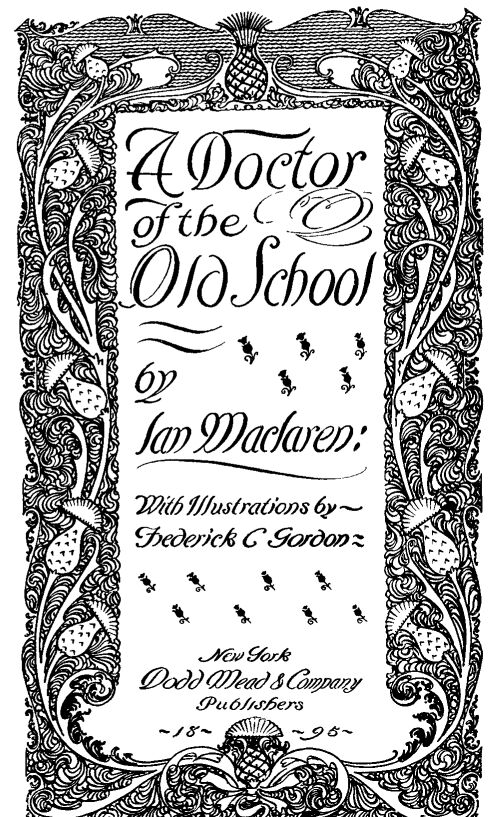
Vintage Recipes: From the Country Doctor

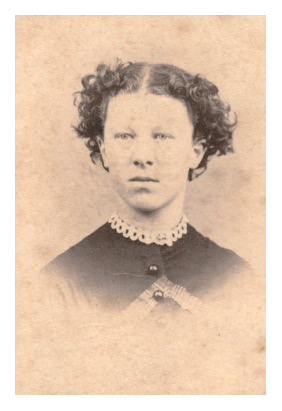
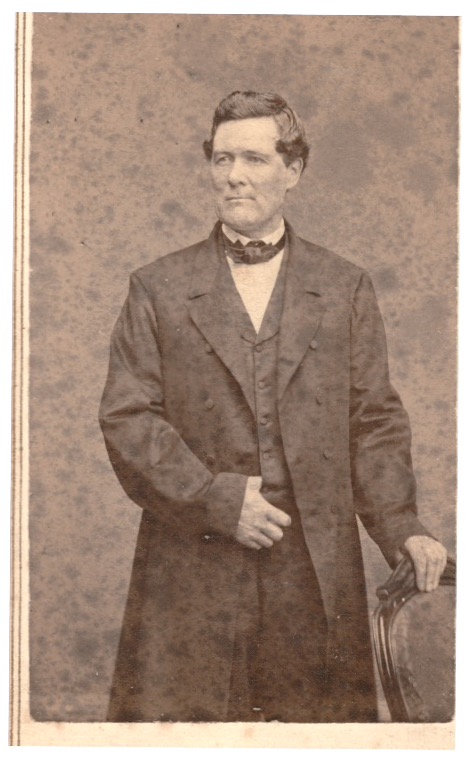
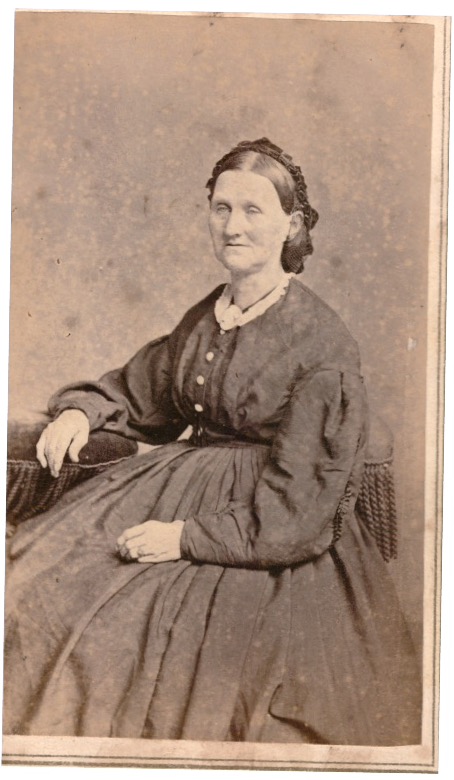
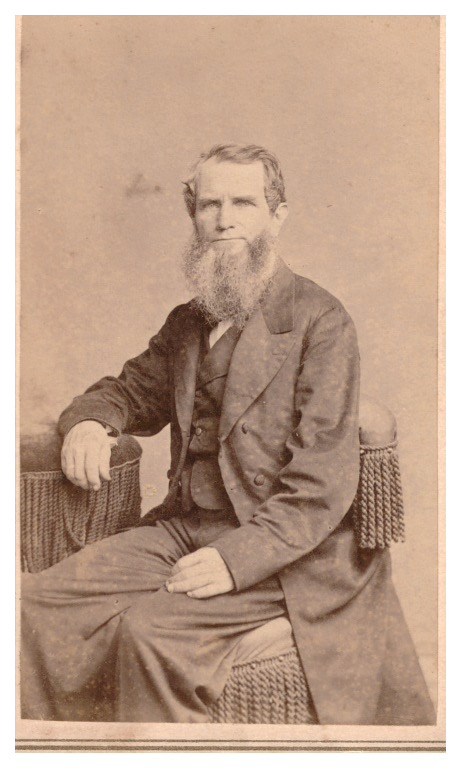
Burton Coon references” “old Dr. MacClure of Drumtochty” in Recognition of the Country Doctor below.

Vintage Recipes: from the Country Doctor

Auntie (Esther Coon Rider 1905-1993) was a natural cook known for her generosity of spirit and her love of cooking- frequently with ingredients grown in the kitchen garden. She thrived on providing pleasure and sustenance through her soul food- that heart and stomach warming fare needed after a day on the farm or a walk in the fresh country air. I treasure the time I spent in her kitchen and her recipes – those she created, those she collected and those she acquired from previous generations.

What I did not realize until this extended time of contemplating and organizing (Covid-19) was that her collection of recipes included those from several doctors. For many centuries, the kitchen garden was functional; the plants and herbs grown had specific purposes whether nutritional, medicinal, and/or ornamental. From Chaucer’s knowledge of medicinal remedies in “The Canterbury Tales” (1392) to Shakespeare’s Friar Laurence describing the healing powers of plants and herbs in “Romeo and Juliet” (1594) to the journals and notations of Auntie and her ancestors, cure for ailments was as close as the kitchen garden to be administered by a monk, the cook, the country doctor, or perhaps the local medicine man or woman (to be shared and developed in another post).

Mustard Plaster (Dr. Cookingham)

1 teaspoonful of dry mustard
1 teaspoonful of flour
Stir to a medium paste with vinegar. 
Spread between two pieces of muslin cloth and warm before it is applied.
If a larger one is needed take larger equal portions of mustard and flour.
White of egg prevents blistering.

In his article “Recollections of Red Hook: The Country Doctor”, Burton Coon (1869-1942) recalls “The first doctor I remember was Dr. Cookingham to whom I was taken for treatment when about five years old. He was then unmarried, and boarding with the widow Benedict, and I believe had his office there” (Memories of Old Red Hook From the Burton Coon Collection).

Cool Drinks for Fever (Dr. Morrison)

Cool Drinks for Fever

Juice of 2 oranges and 1 lemon and 1 quart of water
1 tablespoon cream of tartar
2 tablespoons of sugar

Tomato Cocktail
Large can of tomatoes with 1 cup of water
Put through colander.
Juice of 1 lemon
1 teaspoon of horseradish
1 teaspoon of worcestershire sauce
Pepper and salt

With or without fever, these recipes are familiar to those who desire a cool drink today. I suspect Diane Lapis, local researcher and President of the Board of Trustees at the Beacon Historical Society, has included a version of the Tomato Cocktail in her book Cocktails Across America: A Postcard View of Cocktail Culture in the 1930s, ’40s, and ’50s. I look forward to acquiring an autographed copy this Summer!

Imperial Drink for Illness (Dr. Cotter)

1 quart of water
Juice of 2 lemons
1 small teaspoon cream of tartar
Use as you would water.

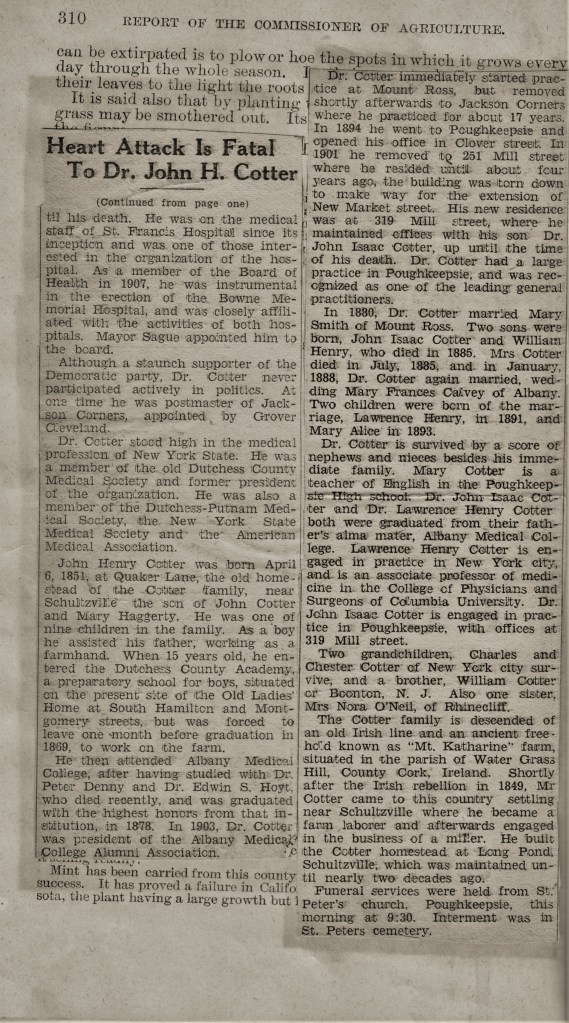
View the two page obituary of this renowned physician, owner of a farm in Jackson Corners.
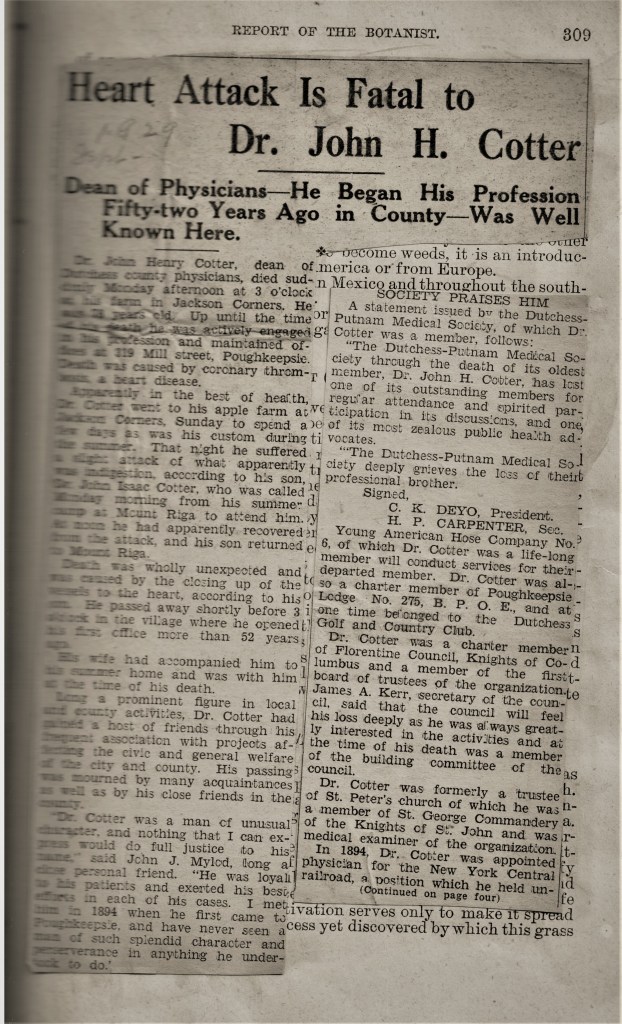
Included in Burton Coon’s scrapbook in Report of the Botanist.

In Recognition of the Country Doctor

At any time in history, recognition of those in the medical profession is appropriate. Today as we experience Covid-19 history in the making, it is apropos to include Burton Coon’s recognition of physicians in his newspaper article “Recollections of Red Hook: The Country Doctor” written in the early 20th century. Coon concludes with these words, “The country doctor is fast passing out of our civilization. Time was when no storms were too heavy, no snow banks too high, no roads too bad to travel when he heard the call; and like old Dr. MacClure of Drumtochty, he rode or waded as the case required. If the case was a serious one he would stay on the job, watching the progress of the disease, while the lamp of life burned low and the watchers stood about with anxious faces. And there are other risks besides the weather and the roads. The doctor always stands a chance of contracting certain diseases himself. One doctor died of erysipelas which he got while treating a patient with the same disease. When there is an epidemic the doctor is exposed to its contagion more than anyone else. Yet no one thinks of the doctor except to get his help. All honor to the worthy sons [and daughters (2020 update)] of this profession who literally take their lives in their hands to minister to their fellow human beings” (Memories of Old Red Hook From the Burton Coon Collection).
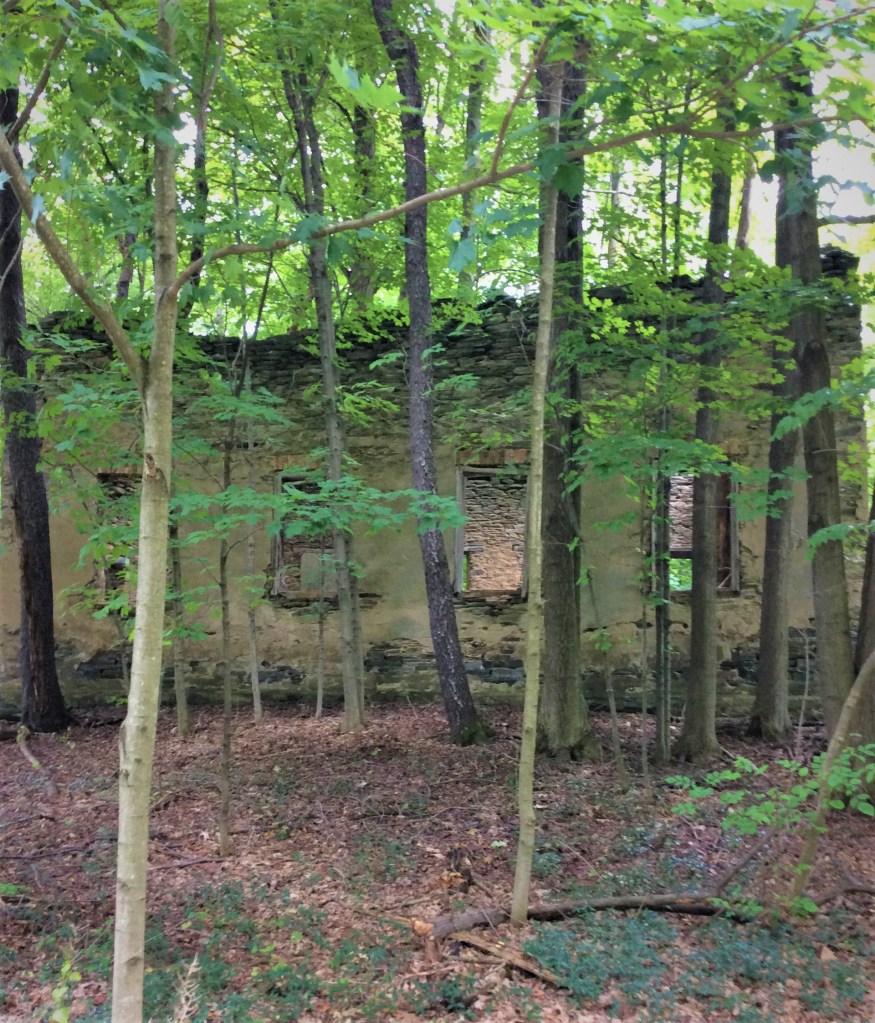
Stories of the Past: Shookville: A “Deserted Village”

Shookville Methodist Church; Photo taken July 27, 2017
Courtesy of Bonnie Wood @ https://keepingnyhistoryalive.com/

Video presentation

A Walk in Shookville

If you wander the winding roads of Milan in Upper Dutchess County, New York, you may miss the hamlet of Shookville on Shookville Road in the blink of an eye. The walls and foundation of the old stone church remain to mark the center of the long-forgotten community, and this stone plaque is displayed near the Town Historian’s office in the Milan Town Hall.

Shookville – The Methodist Church – “This Church, dedicated June 7th, 1834, was erected by local landowners Jacob and Peter Shook for the benefit of the German Reform & Methodist denominations.” ; Photo taken by Bonnie Wood.

Although little of Shookville remains, the articles, journals, and stray thoughts of unofficial local historian and writer Burton Coon (1869-1942) remain to tell the story of its past. In “Shookville: Then and Now” published in the Rhinebeck Gazette, he writes,

"If some of the Shookville boys, who years ago left their native hamlet should come back to the old home they would find only a plowed field, with here and there a shrub or a grape vine or an old garden flower to mark the spot.

Kate April's house and garden and the loom that wove such rugged tapestry have long since disappeared and only a hedge of tansy and a few clumps of Bouncing Bet have survived the change.

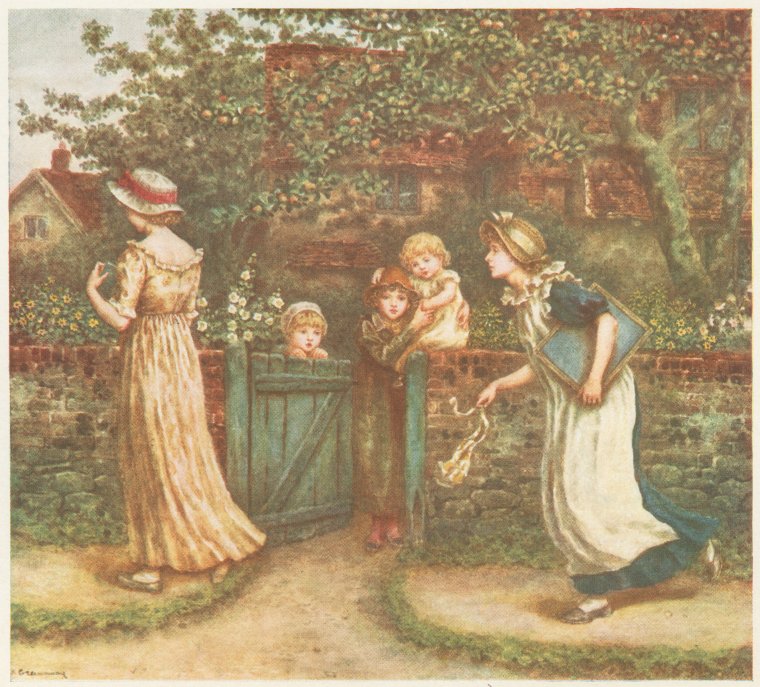
David Doyle and Jennie Cramer would look in vain for the little picket gate in the stone wall, and the shrubs on either side of the stone walk leading to the house and grape vine and the little garden with its pinks and Sweet William and lavender. Many a bouquet did Mother Doyle pick from this yard and bring to church on a Sunday afternoon, an offering for God's altar."
Courtesy of New York Public Library. (Artist Kate Greenaway 1846-1901)
The Miriam and Ira D. Wallach Division of Art, Prints and Photographs: Picture Collection, The New York Public Library. “Lucy Locket lost her pocket.” The New York Public Library Digital Collections. http://digitalcollections.nypl.org/items/68dc0359-77f0-7a41-e040-e00a1806442f
"And Gilbert Myers will remember the old home with over-shadowing plum trees, white in the Springtime and the little barn where the cow and chickens were kept and the hay loft where he used to dream of the days to come and their possible fruitage."
Courtesy of New York Public Library (Artist Kate Greenaway 1846-1901)
The Miriam and Ira D. Wallach Division of Art, Prints and Photographs: Picture Collection, The New York Public Library. “Diddlty, diddlty, dumpty.” The New York Public Library Digital Collections. https://digitalcollections.nypl.org/items/68dc0359-7814-7a41-e040-e00a1806442f
"I might remind Silas Burger and the Wagner boys and girls and many others who were born or brought up in Shookville.

I can count eight houses, each of which has been occupied by a family within my recollection, and now have almost entirely disappeared. I have been in all of these houses; spent there many a social hour; went to school with some of the children; went to prayer meeting with most of them; and felt perfectly safe in them at any time of day or night. I know of at least five other places where house have stood, all within a mile of the church."
Shookville Methodist Church Photo Courtesy of Milan Town Hall https://milannyhistory.org/portfolio/churches/

Near the remains of the old stone church, the gravestones of many Shookville residents still stand and tell another story of this “deserted village”. Burton Coon’s parents as well as his father William Coon’s three children and a first wife lost in the space of three years 1863-1865 from small pox and then diptheria are buried within the black iron fence. How many others in the hamlet suffered the same fate? William Coon documented his grief in his journal. He described how his teenage daughter Jemima, who was very fond of the little five year old daughter of Philip and Charlotte Coopernail, was determined to visit the sickly child. Jemima and the child both died from diptheria within days of each other in September 1865. “And they are buried inside the iron fence in the old Shookville cemetery, the little one at the feet of the older one. So they are together there in death. At the top of the little one’s stone is the figure of a broken rosebud, and underneath her name and age are the words: ‘Go with me.’ Her friend went…”

"I miss the old inhabitants, too. I remember Philip, Henry, and Charlotte Coopernail, John Ostrander, Uriah St. Paul and his family, Charlie and Will Van Etten and their mother, and many others besides those whom I have already written about, most of whom are dead."

Just a short walk from the church the Coon family farmhouse still stands, though renovated. The stone wall and the stone foundation for the barn remain. The farm lands have been divided, and houses can be viewed where none appeared from 1862-1988.

The deeds and Burton’s description of his father’s purchases of land from 1850-1862 reveal more about the hamlet of Shookville.

"On the 21st day February, 1850, Peter Shook conveyed to my father 22 acres, 2 roods and 10 perches of land for $857.37 1/2... This land was to the east of the buildings and some of it was uncleared... 

On the 2nd day of May 1853, George Shears, who lived where Mrs. Kathryn Frazier now lives, conveyed to my father 44 acres, 3 roods, and 13 perches of land for $1,344.94. This consisted of a wood lot and two cultivated field along the east side of the farm... 

On the 30th day of April 1862, David Coopernail and Electa, his wife, conveyed to my father 35 acres, 2 roods, and 29 perches of land for $1,427.25. This constitutes what is now the north part of the present farm."

What more can we discover about Shookville: the “Deserted Village”? The stories can be remembered and retold. The beauty can still be experienced. Slow down; don’t blink; take a stroll or a bike ride and explore the magnificence of Nature and feel the history all around. We can still imagine the community gathering at church socials, the children playing in the orchard and going to a one-room school house, the farmer plowing the field, the farmer’s wife picking vegetables in her kitchen garden. A quiet yet active time; a hard yet cherished life…

Making History

Let’s end with Burton Coon’s closing words in his article “Shookville: Past and Present”.

"Truly, we have here a deserted village. Would that some writer with more genius than I have might describe it and tell its story. For these plain people have served their day and generation and made history as certainly as any people anywhere. I have long wanted to do them justice and if I have failed, it is only because I could not do any better. I thank the Gazette for the opportunity."
                                     Burton Coon

Stories of the Past- Just a Torn Scrap of Paper

Just a torn scrap of paper preserved within the pages of another text of related topic, but not belonging~
Redman, Jacques and Hinman, Russell. “Natural Advanced Geography”. American Book Company. 1898.
Click the arrow on the Instagram post to view 7 more photos after the collage.
Photo Series “Advanced Geography 1898” : 1st image: Collage: Several photos from “Advanced Geography” ; 2nd image: Montauk Lighthouse; 3rd image: Adirondacks; 4th image: Albany; 5th image: the torn page; 6th image: Publisher; 7th image: Title page; 8th image: Webster Coon’s inscription on the inside of the front cover.

Just a Torn Scrap of Paper

Stories of the past are often tucked within the pages of old books. In this case, the details in the sketches on a torn scrap of paper found in student Webster Coon’s “Natural Advanced Geography” fascinates me. I am drawn first to the three circular focus frames placed above another sketch. The first circle is of Albany with a cityscape serving as a backdrop to the river, framed by a conifer. In contrast, the second focus frame depicts the serenity of the Adirondacks with the highest mountains in New York standing tall in the background. It is the central focus frame, but it is overlaid by the two other frames. National Maritime Historic Landmark Montauk Lighthouse constructed in 1796 and still operational as a navigational tool draws the viewer’s eye, yet there are two figures on the cliff and several below who in view of the rough waters and rocks of the Atlantic Ocean seem insignificant. In terms of details, the sketch of numerous water vessels beneath the three circles is the most remarkable of the collection.

This focus on water is fitting and explained in these two sections of text on the torn page: “Position and Rank” and “Outline and Boundaries”.

Position and Rank

“The geographical position of New York, – between the Great Lakes on the west, and the Atlantic Ocean on the south-east, – together with its natural facilities for water-communication, enlarged by canals, has given the state its foremost rank in the Union for population, commerce, and wealth, and its title of the “Empire State”.

Just a torn scrap of paper preserved within the pages of another text of related topic, but not belonging~
Redman, Jacques and Hinman, Russell. “Natural Advanced Geography”. American Book Company. 1898.

Outline and Boundaries

“The outline of this state is very irregular. Only a little over one-third of its boundary consists of straight lines, the other two-thirds being formed by bodies of water, including Lake Erie, the Niagara River, Lake Ontario, part of the St. Lawrence River, and Lake Champlain. The linear boundaries make about 541 miles; the water boundaries, 879 miles.”

Just a torn scrap of paper preserved within the pages of another text of related topic, but not belonging~
Redman, Jacques and Hinman, Russell. “Natural Advanced Geography”. American Book Company. 1898.

Discover

What will I discover next within the pages of an old book? Share your findings in the comments section.

Vintage Recipes: From the Pumpkin Patch 10/27/19

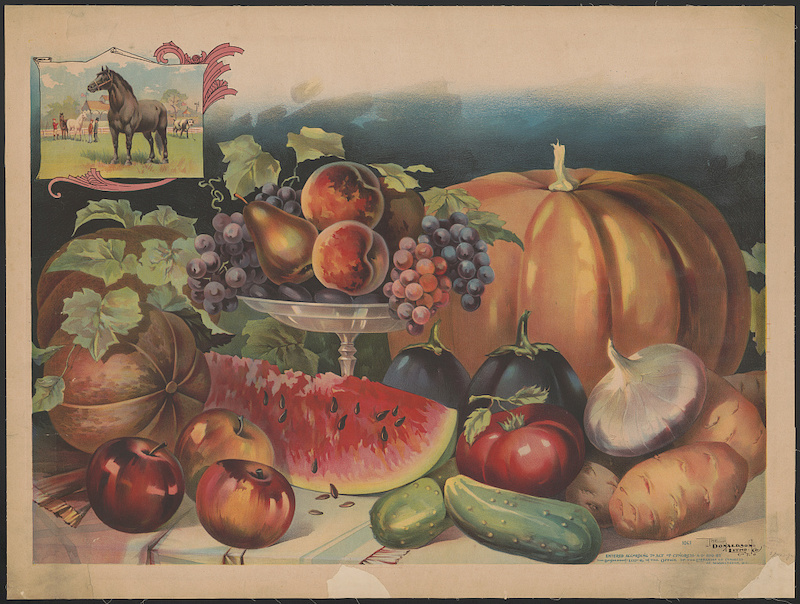
“Farm produce with small image of horse in the upper left corner”; chromolithograph. Library of Congress. 1893.

Picking the perfect pumpkin is a family tradition. Whether a miniature or the largest pumpkin in the field is chosen to adorn the front step, much discussion and deliberation ensues. Each year, the trip to the pumpkin field ignites memories beginning with “Remember when…”. The excitement and resulting anticipation heightens while bumping through the field on a wagon ride.

Children spring from the wagon and scatter through the field. Some will choose the first one spotted; others will wander for a while with much consideration; one great thinker seemingly arrives on each wagon ride. The most patient driver becomes restless. The other children begin to call. A set of parents begins to apologize as their child carries several pumpkins to a central location and checks for imperfections. Those that do not make the final cut may have a speck of dirt, a rough patch, or perhaps a slightly irregular shape, but the child knows that there is only one “Great Pumpkin, Charlie Brown”!

The Pumpkin

Oh, fruit loved of boyhood! the old days recalling,
When wood-grapes were purpling and brown nuts were falling!
When wild, ugly faces we carved in its skin,
Glaring out through the dark with a candle within!
When we laughed round the corn-heap, with hearts all in tune,
Our chair a broad pumpkin,—our lantern the moon,
Telling tales of the fairy who travelled like steam,
In a pumpkin-shell coach, with two rats for her team!

Whittier, John Greenleaf. The Pumpkin.

Harvest time on all parts of the farm was busy yet rewarding. In the kitchen, Auntie’s passion for cooking brought joy to family and friends. Each Autumn, I recall the aroma of Auntie’s pumpkin pie.

Auntie’s Recipe for Pumpkin Pie

  • 2 cups of stewed pumpkin
  • 1/2 teaspoon salt
  • 1/2 teaspoon cinnamon
  • 2/3 cup of sugar
  • 1 teaspoon ginger
  • 2 eggs
  • 1 scant pint of milk
  • Bake 45 minutes.
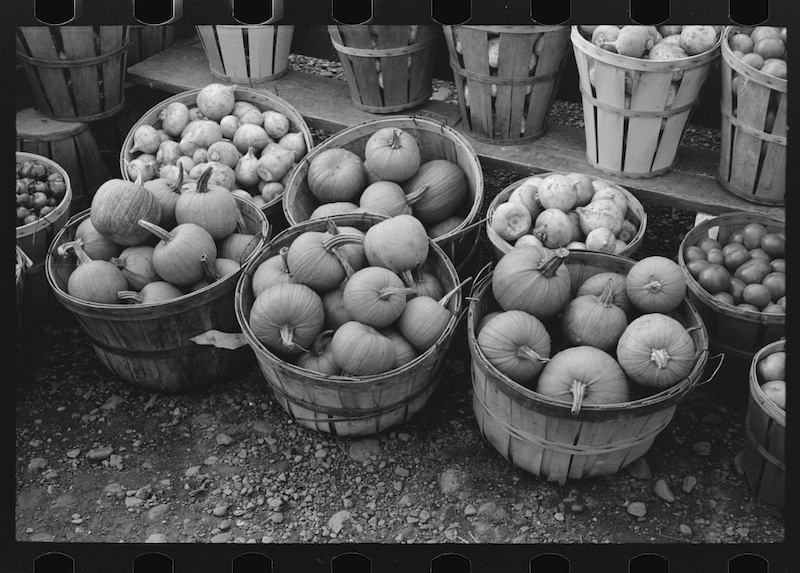
Lee, Russell, photographer. Pumpkins and turnips near Berlin, Connecticut. Library of Congress. October 1939.
Lee, Russell, photographer. Cutting up Pumpkin for Pie. Bakery San Angelo, Texas Library of Congress. November 1939.
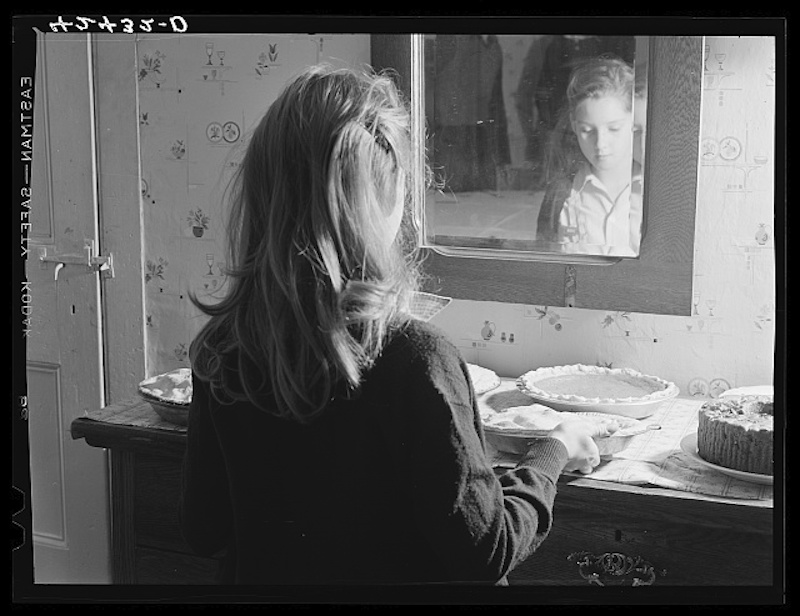
Delano, Jack. At the Crouch family Thanksgiving Day dinner. Pumpkin pies. Ledyard, Connecticut. Library of Congress. November 1940

Vintage Recipes: All About Fruit 8/31/19

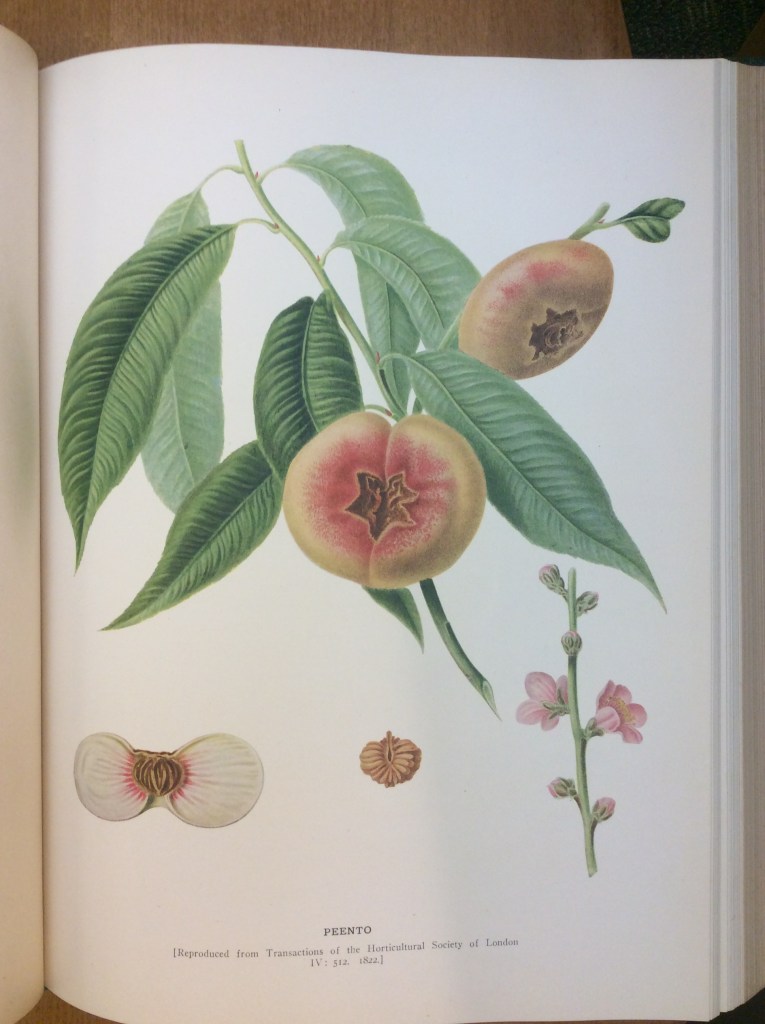
Inspiration sometimes derives from the most commonplace thought. When I was captivated with two thick volumes entitled The Cherries of New York and The Peaches of New York dated 1914 and 1915 respectively, I realized how many of my most precious moments included fruit.

Simple idea yet I can plot my growth from child to woman with such experiences. As a child, I recited Eugene Fields’ children’s poem, “The Little Peach”

"A little peach in the garden grew,
A little peach of emerald hue;
Warmed by the sun and wet by the dew, it grew.
One day, passing that orchard through
That little peach dawned on the view...",

learned the Biblical account of Eve eating the forbidden fruit, and viewed many artists’ depictions of fruit arrangements. Despite my appreciation for the arts, it was another role that impacted me even more.

I selected apple drops from beneath the trees in Grandpa’s orchard. The story I learned as a child was that Grandpa, a dairy farmer, had researched which apples would grow best in Dutchess County before purchasing a few additional acres that were set at a higher elevation overlooking rolling hills. In an orchard that already included some old apple trees, he planted Red Delicious, Yellow Delicious, McIntosh, and (I believe) Cortland. His research proved insightful as the trees bore delicious and well-formed apples for many years.

This childhood adventure began when our car climbed up the bumpy pathway. When we arrived, we jumped out and ran to select “our” tree. My brother and I were not allowed to climb the ladders; we were in charge of clearing the area beneath each tree. The drops were generally only slightly bruised but could not be sold at full price and were sometimes fed to the farm animals.

After descending from the orchard, we would go to visit Grandma who owned the local general store. She would arise early to bake apple pies and bread at home for her customers. Sometimes she would ask me to help her in the store. Using the old cash register, putting candy bars in the ice cream freezer to prevent melting in the summer, and going down to the crick beneath the bridge were memorable times.

On another farm in Milan, NY where my Grandma grew up, my great-grandfather Burton Coon wrote in his journal entry for Thursday July 18, 1907:

"75 degrees- 5am; foggy, quiet
74 degrees- 9:30pm; partly cloudy
Humid in am-
Showers in pm
picked pail cherries
cut weeds along fence in upper garden
and found wood chuck hole
used trap-got him alright
pulled weeds from sweet corn
and planted a little
pm-raked up
cleaned rifle
42 eggs"

My Auntie was only two when her father wrote that journal entry, but she continued to live at Trail’s End and harvest the fruits and vegetables her whole life. The following recipes were preserved in her recipe box.

Auntie’s Vintage Recipes

Strawberry Cocktails

Slice long, fine berries.
Cover them with orange juice and stand on ice.
Add a teaspoon of powdered sugar.
Serve in sherbet glasses.
Mrs. Horace Dutcher
Peach Melba

Into sherbet glasses, put small squares or slices of plain cake or lady fingers,
half a preserved peach,
2 tablespoons of plain ice-cream,
juice of cooked fruit,
2 tablespoons of whipped cream,
and garnish with Maraschino cherry.
Serve cold.
Mrs. F. S. Rogers
Strawberry Shortcake

2 cups flour
1/2 teaspoon salt
2 tablespoons sugar
4 teaspoons Royal Baking Powder
3 tablespoons shortening
1 egg
1/2 cup milk

Sift dry ingredients,
mix in shortening;
add beaten egg to milk and
add to dry ingredients to make soft dough.
Smooth one half of dough out lightly.
Put into greased deep layer tin;
spread with butter;
cover with other half of dough which has
also been smoothed out to fit pan.
Bake in hot over 20 to 25 minutes.
Split while hot and
spread crushed and sweetened berries
and whipped cream between layers;
cover top with whipped cream and
whole berries.
Dust with powdered sugar and serve.
Peach Marmalade

10 pounds peaches when peeled and cut small;
7 pounds granulated sugar;
1 teaspoon ground cinnamon;
1/2 teaspoon ground ginger;
1/2 scant teaspoon ground allspice;
1/2 scant teaspoon ground cloves.

Put all in preserving kettle on back of stove and melt down slowly. Bring to front of fire and cook until quite thick, stirring constantly. Remove any scum which may arise. If peaches seem tart, add a little more sugar.
Mrs. Anna B. S.

Strawberry shortcake at a small-town church
Hot apple cider with an old-fashioned donut
Caramel or candied apples?
What are your favorite fruit recipes?

Stay tuned for more of Auntie’s Vintage Recipes next time.

Vintage Recipes: From a Farm Stand 8/10/19

From a Farm Stand

Zucchini, patty pans, onions, scallions, and beets displayed in a vintage basket. Vegetables purchased from a farm stand in Milan, NY in July 2019.

What is the lure of a farm stand?

Meandering the backroads of New York state, I have frequently passed farm stands. What is it that makes some of us stop and return to take a closer look?

A few weeks ago, I pulled into a farm stand in Milan, NY. At first, it appeared to be a simple setup with some vegetables arranged on a wooden table. When I approached a gentleman seated on a lawn chair, we greeted each other before I began to examine what was on display. A jumble of vintage books in a crate and other curiosities surrounded him. He slowly began to tell some stories about the items, and I prompted him with questions and some of my memories of visiting relatives at Trail’s End Farm.

Gradually, I explained my fascination with stories passed down through the generations, and he began to tell me about his origins as a Czech immigrant. His eyes sparkled and his voice became resonant as he recalled those earlier days and a time that was pivotal in the life of his family. It is not only his poignant story which should be heard but also those stories in our own families or communities.

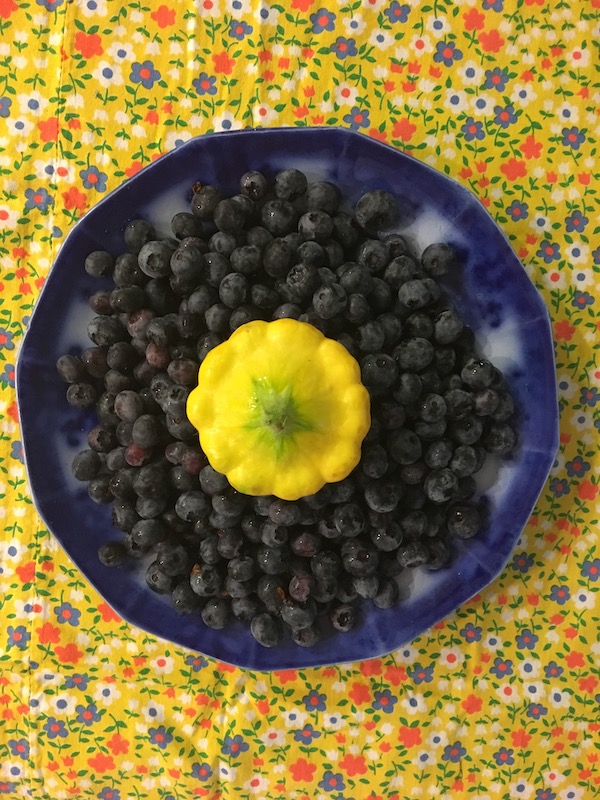
Patty Pan and blueberries are displayed on a Davenport Flow Blue plate and vintage table cloth.

As his story ended, I realized that I hadn’t chosen any vegetables for dinner. A vivacious young lady assisting him packed up my selection ranging from patty pans to blueberries. After we said our goodbyes, I drove away wondering…

  • What is the lure of a farm stand?
  • Is it the beauty of the palette of nature?
  • Is it the succulent flavor to add to our meal?
  • Is it the yearning for a simpler life?
  • Does it bring back memories?

Whatever compels me, you may still find me stopping at a farm stand… What are your memories of a farm stand?

Canned Berries

  • Blackberries, blueberries, huckleberries, raspberries, loganberries, gooseberries and strawberries should be canned as soon as possible after picking.
  • Hull or stem.
  • Place in strainer and wash by lifting up and down in pan of cold water.
  • Pack into hot sterilized glass jars, using care not to crush fruit.
  • To insure a close pack, put a 2 or 4 inch layer of berries on the bottom of the jar and press down gently with spoon.
  • Continue in this manner until jar is filled.
  • Boiling water or boiling thin or medium syrup should be poured over the fruit at once.
  • Loosely seal.
  • Sterilize 10 minutes in boiling water.
  • Remove jars, tighten covers, invert to test seal and cool.

Note: This torn and yellowed recipe was preserved in Auntie’s recipe box.

Unidentified Photos

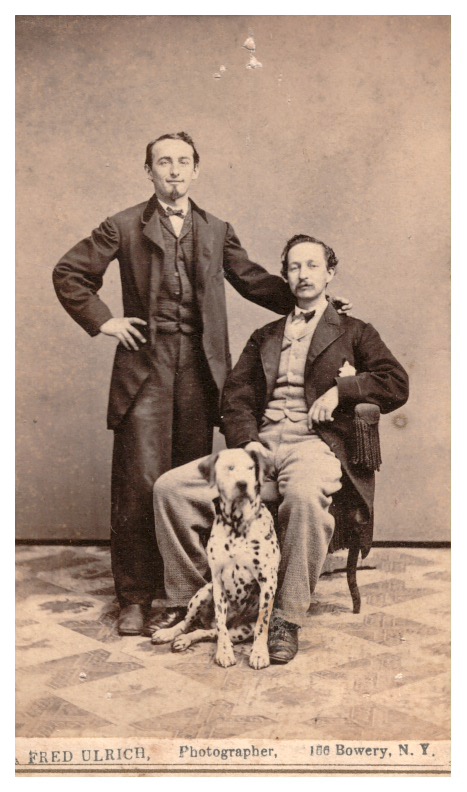
These unidentified photos were all preserved at Trail’s End Farm in Milan, NY by Burton Coon (1869-1942) and his wife Emma Schultz Tipple Coon (1869-1956).

I wonder…

Who is in the photo?

Are they relatives, friends, neighbors?

What is the occasion?

What is the story?

Thank you for viewing this gallery.

Your comments and suggestions are welcome.

Vintage Recipes: From Auntie’s Kitchen 7/13/19

Auntie’s recipes dating from the early 1900s were well-used and spattered with years of good cooking yet preserved in this box.

As I select vintage recipes to transcribe from Auntie’s recipe box, I recall those treasured moments in her kitchen when I observed and assisted or perhaps hindered her progress with the meal.

photographer: Dorothea Lange, Mrs. Granger’s storeroom. 1939 She has 500-600 quarts of canned food. “You never know what may happen.” Yamhill farms. (FSA – Farm Security Administration). Yamhill County, Williamette Valley, Oregon. “From the NY Public Library”
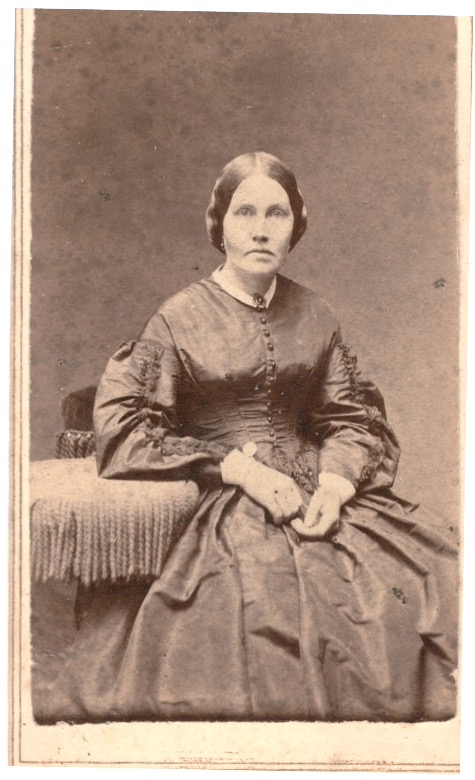
My memories of the cooking experience include my hesitant journey into the dirt floor cellar of the old farmhouse to retrieve a Mason jar of the requested fruit canned the previous season. Slowly, I took the first step on the worn narrow stairs illuminated with a swinging dusty bulb. I viewed the cobwebs, smelled the dust, and felt the damp chill of being underground.

I proceeded cautiously toward the wooden shelf containing neatly lined and labelled Mason jars. With two hands tightly grasping the blue glass jar, I turned around and saw shadows in the dark corners. An avid reader of the Hardy Boys and Nancy Drew, I imagined myself the protagonist of my own mystery …

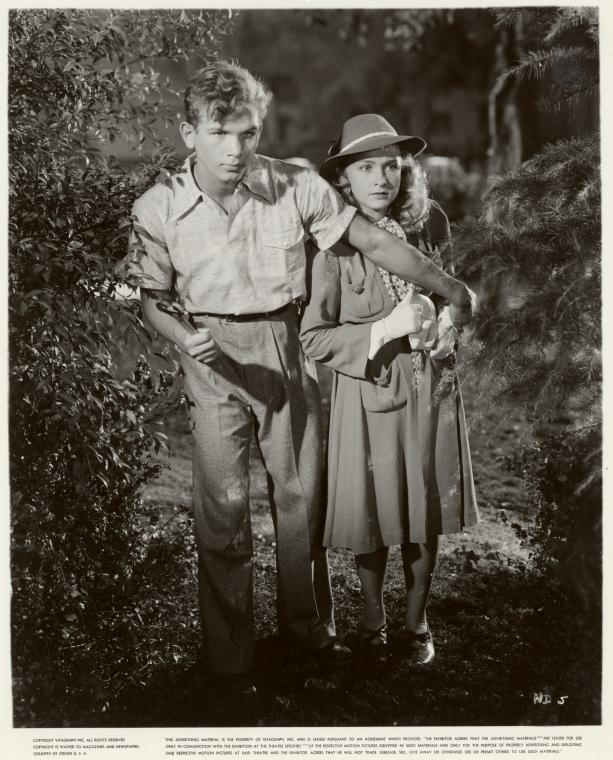
Film Still From Nancy Drew: Detective; 1938 “From the NY Public Library”

until I heard my Auntie calling.

Auntie was the best cook that I can recall. What are your memories of a favorite cook?

Desserts

Chocolate Caramels

  • 1 cup of milk
  • 2 cups of sugar
  • 1/2 cup of molasses
  • 1/2 cake of Baker’s chocolate

Boil an hour and cool on buttered tins.

Courtesy of Mrs. A. Campbell

Tapioca Cream

  • 2 tablespoons of tapioca, soaked in cold water.
  • Set on the stove.
  • When thoroughly dissolved, pour in a quart of milk.
  • When this begins to boil, stir in the yolks of two eggs, well beaten.
  • Stir in a cup of sugar.
  • When this boils stir in the egg whites, beaten to a stiff froth.
  • Take immediately from the fire.
  • Flavor to taste.

Courtesy of Mrs. A. Campbell

Content: C.W.S. Cigarettes – England. Cigarette Card; “From the NY Public Library”

Ruth’s Layer Cake

(Ruth may have been Ruth Coons of Barrytown, NY- the site of memorable July Fourth Family Gatherings.)

  • 1 cup of butter or lard
  • 2 level cups of sugar
  • 4 eggs (separated)
  • 1 cup milk
  • 4 level cups of flour
  • 4 teaspoons of baking powder
  • 1 level teaspoon of salt

Bake in 4 layers.

Auntie’s box of recipes includes cooking-related ephemera of the time.

Apple Custard

  • Pare and core half a dozen very tart apples;
  • cook them in half a tea cup of water till they begin to soften;
  • put them in a pudding dish and sugar them;
  • beat eight eggs with four spoons of sugar;
  • add three pints of milk;
  • pour over the apples and bake half an hour.

Shared by Miss M. A. Hedden

Included in Auntie’s box of recipes.

Breads

Biscuits

  • Into a quart of sifted flour put two heaping teaspoons of baking powder and a pinch of salt;
  • mix together while dry;
  • then rub into it a piece of lard a little larger than an egg; mix with cold sweet milk;
  • roll thin;
  • cut with a tin cutter;
  • and bake a light brown in a hot oven.

Send to the table immediately.

Come back to visit again soon. New recipes will be added each week.