Stories of the Past- Just a Torn Scrap of Paper

Just a torn scrap of paper preserved within the pages of another text of related topic, but not belonging~
Redman, Jacques and Hinman, Russell. “Natural Advanced Geography”. American Book Company. 1898.
Click the arrow on the Instagram post to view 7 more photos after the collage.
Photo Series “Advanced Geography 1898” : 1st image: Collage: Several photos from “Advanced Geography” ; 2nd image: Montauk Lighthouse; 3rd image: Adirondacks; 4th image: Albany; 5th image: the torn page; 6th image: Publisher; 7th image: Title page; 8th image: Webster Coon’s inscription on the inside of the front cover.

Just a Torn Scrap of Paper

Stories of the past are often tucked within the pages of old books. In this case, the details in the sketches on a torn scrap of paper found in student Webster Coon’s “Natural Advanced Geography” fascinates me. I am drawn first to the three circular focus frames placed above another sketch. The first circle is of Albany with a cityscape serving as a backdrop to the river, framed by a conifer. In contrast, the second focus frame depicts the serenity of the Adirondacks with the highest mountains in New York standing tall in the background. It is the central focus frame, but it is overlaid by the two other frames. National Maritime Historic Landmark Montauk Lighthouse constructed in 1796 and still operational as a navigational tool draws the viewer’s eye, yet there are two figures on the cliff and several below who in view of the rough waters and rocks of the Atlantic Ocean seem insignificant. In terms of details, the sketch of numerous water vessels beneath the three circles is the most remarkable of the collection.

This focus on water is fitting and explained in these two sections of text on the torn page: “Position and Rank” and “Outline and Boundaries”.

Position and Rank

“The geographical position of New York, – between the Great Lakes on the west, and the Atlantic Ocean on the south-east, – together with its natural facilities for water-communication, enlarged by canals, has given the state its foremost rank in the Union for population, commerce, and wealth, and its title of the “Empire State”.

Just a torn scrap of paper preserved within the pages of another text of related topic, but not belonging~
Redman, Jacques and Hinman, Russell. “Natural Advanced Geography”. American Book Company. 1898.

Outline and Boundaries

“The outline of this state is very irregular. Only a little over one-third of its boundary consists of straight lines, the other two-thirds being formed by bodies of water, including Lake Erie, the Niagara River, Lake Ontario, part of the St. Lawrence River, and Lake Champlain. The linear boundaries make about 541 miles; the water boundaries, 879 miles.”

Just a torn scrap of paper preserved within the pages of another text of related topic, but not belonging~
Redman, Jacques and Hinman, Russell. “Natural Advanced Geography”. American Book Company. 1898.

Discover

What will I discover next within the pages of an old book? Share your findings in the comments section.
Vintage Recipes: From the Pumpkin Patch 10/27/19

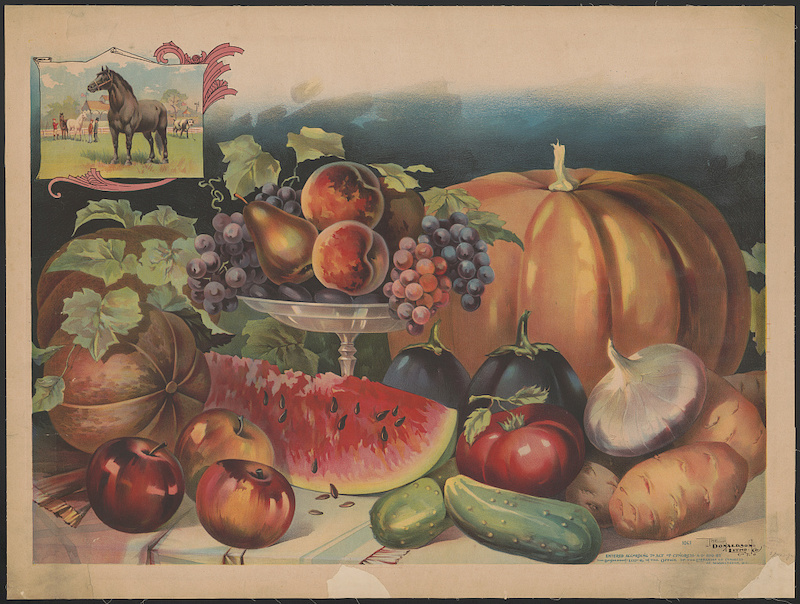
“Farm produce with small image of horse in the upper left corner”; chromolithograph. Library of Congress. 1893.

Picking the perfect pumpkin is a family tradition. Whether a miniature or the largest pumpkin in the field is chosen to adorn the front step, much discussion and deliberation ensues. Each year, the trip to the pumpkin field ignites memories beginning with “Remember when…”. The excitement and resulting anticipation heightens while bumping through the field on a wagon ride.

Children spring from the wagon and scatter through the field. Some will choose the first one spotted; others will wander for a while with much consideration; one great thinker seemingly arrives on each wagon ride. The most patient driver becomes restless. The other children begin to call. A set of parents begins to apologize as their child carries several pumpkins to a central location and checks for imperfections. Those that do not make the final cut may have a speck of dirt, a rough patch, or perhaps a slightly irregular shape, but the child knows that there is only one “Great Pumpkin, Charlie Brown”!

The Pumpkin

Oh, fruit loved of boyhood! the old days recalling,
When wood-grapes were purpling and brown nuts were falling!
When wild, ugly faces we carved in its skin,
Glaring out through the dark with a candle within!
When we laughed round the corn-heap, with hearts all in tune,
Our chair a broad pumpkin,—our lantern the moon,
Telling tales of the fairy who travelled like steam,
In a pumpkin-shell coach, with two rats for her team!

Whittier, John Greenleaf. The Pumpkin.

Harvest time on all parts of the farm was busy yet rewarding. In the kitchen, Auntie’s passion for cooking brought joy to family and friends. Each Autumn, I recall the aroma of Auntie’s pumpkin pie.

Auntie’s Recipe for Pumpkin Pie

  • 2 cups of stewed pumpkin
  • 1/2 teaspoon salt
  • 1/2 teaspoon cinnamon
  • 2/3 cup of sugar
  • 1 teaspoon ginger
  • 2 eggs
  • 1 scant pint of milk
  • Bake 45 minutes.
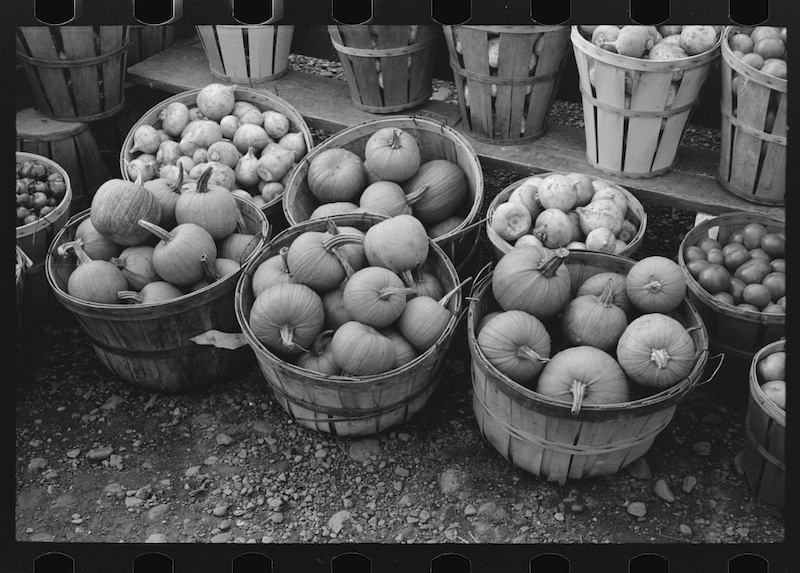
Lee, Russell, photographer. Pumpkins and turnips near Berlin, Connecticut. Library of Congress. October 1939.
Lee, Russell, photographer. Cutting up Pumpkin for Pie. Bakery San Angelo, Texas Library of Congress. November 1939.
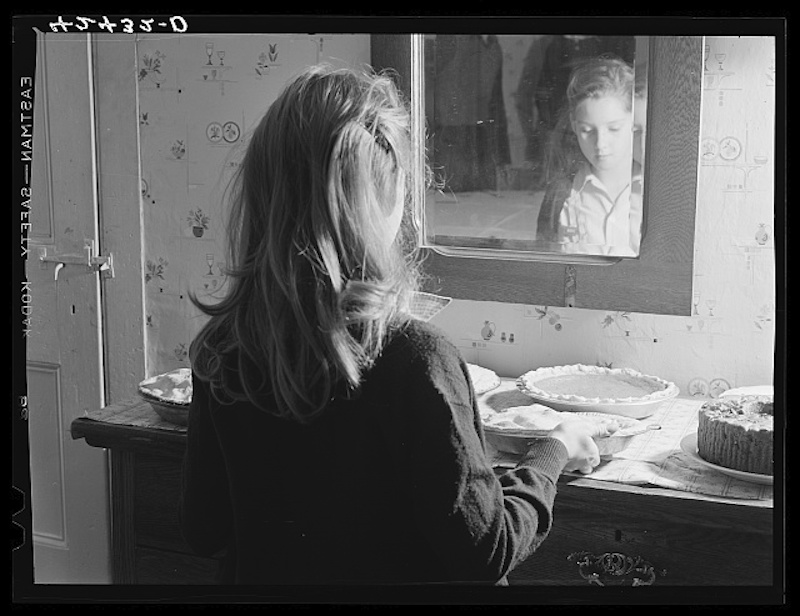
Delano, Jack. At the Crouch family Thanksgiving Day dinner. Pumpkin pies. Ledyard, Connecticut. Library of Congress. November 1940